

Beyond Beauty: How the Arts Shape Meaning, Memory, and Modern Life
What We Mean by “the Arts”
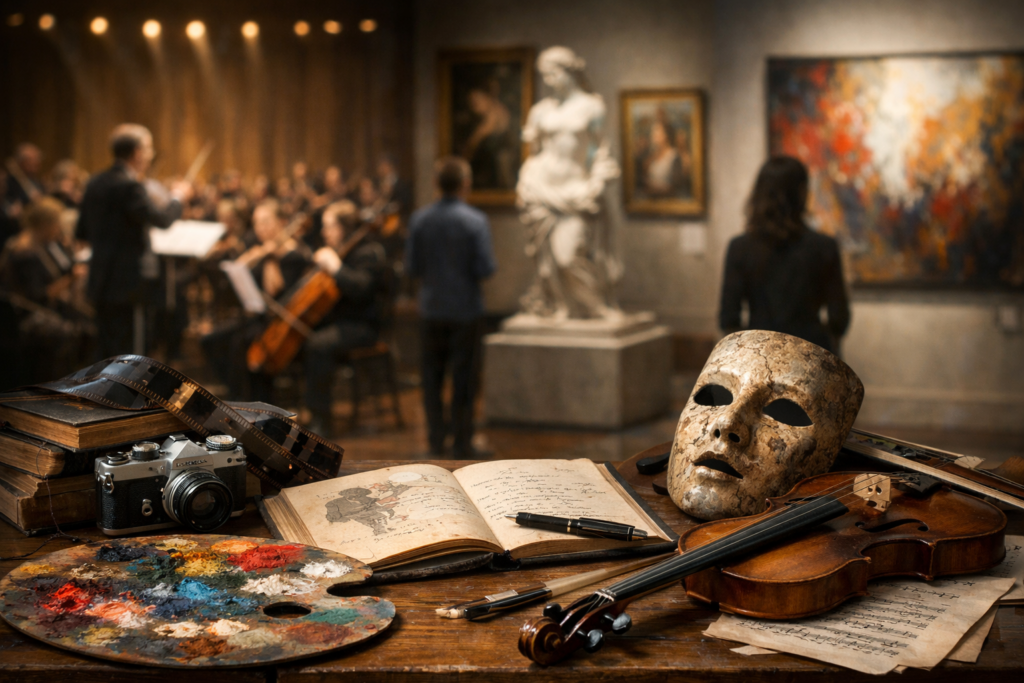
The arts are a broad family of human practices that use skill, imagination, and craft to express ideas and evoke experiences. They include the visual arts (painting, sculpture, photography, design), performing arts (theatre, dance, music), literary arts (poetry, fiction, essays), and increasingly media and digital arts (film, animation, interactive installations, games). While each discipline has its own traditions and techniques, they share a common aim: to shape perception—how we see, feel, and understand the world.
Unlike purely functional communication, art often works through metaphor, ambiguity, rhythm, composition, and symbolism. It can be direct or puzzling, intimate or public, comforting or challenging. This flexibility is not a weakness; it is one of the arts’ defining strengths, allowing them to hold multiple truths at once.
Why the Arts Matter in Everyday Life
It is easy to associate the arts with galleries, concert halls, or elite spaces, but art lives everywhere: in album covers, street murals, choreography on social media, product design, architecture, and the stories people tell about themselves. The arts matter because they provide languages for experiences that are difficult to describe otherwise—grief, joy, longing, identity, awe.
At a personal level, engaging with the arts can sharpen attention and expand emotional range. A novel can make unfamiliar lives feel close. A song can carry a memory more vividly than a photograph. A carefully designed chair or app interface can reduce friction and bring a quiet sense of ease. In this sense, the arts are not separate from life; they are a way of noticing life.
Forms of Art: A Living Ecosystem
Visual Arts
Visual art communicates through shape, color, light, texture, and composition. From cave paintings to contemporary installations, it reflects changing ways of seeing. Photography, for example, transformed how societies document events and represent identity, while modern design influences how we navigate everything from signage to websites.
Performing Arts
The performing arts unfold in time and often rely on the presence of an audience. Theatre and dance use bodies and space to express conflict, humor, ritual, and transformation. Music—whether symphonic, folk, hip-hop, or electronic—organizes sound to generate mood, tension, release, and belonging. Live performance also creates a rare form of shared attention, where strangers temporarily synchronize their emotions and focus.
Literary Arts
Literature shapes inner life. Through voice and narrative, it can interrogate morality, power, and selfhood. Poems compress meaning into a handful of lines; essays refine thinking; fiction allows readers to rehearse empathy by inhabiting other perspectives. Even when stories are invented, they often reveal social realities more sharply than straightforward reporting.
Digital, Media, and Interactive Arts
Film, animation, and games blend disciplines—image, sound, writing, performance, and code. Digital tools also democratize creation: a smartphone can be a studio, a cinema camera, and an editing suite. At the same time, these forms raise new questions about authorship, attention, and authenticity, especially in an era of algorithmic feeds and synthetic media.
The Arts as a Record of Culture—and a Force That Changes It
Art preserves what societies value and what they fear. Portraiture, monuments, protest songs, satire, and documentary films all function as cultural memory. They can also challenge official narratives by elevating overlooked voices and exposing uncomfortable truths. Throughout history, artistic movements have emerged alongside technological and political shifts: print culture expanded literature; industrialization influenced modern architecture and design; recorded sound reshaped music; the internet transformed distribution and collaboration.
Crucially, the arts do not just reflect culture—they actively produce it. Fashion influences identity and group belonging. Cinema shapes collective imagination. Public art can redefine a neighborhood’s sense of place. When people debate art—its meaning, value, or boundaries—they are often debating who gets to be seen and heard.
Learning Through the Arts
Arts education is not only about training future professionals; it builds transferable capacities. Practicing an instrument develops patience and listening. Drawing teaches observation and proportion. Acting exercises interpretation and collaboration. Writing strengthens clarity of thought and sensitivity to language. Because artistic work requires iteration—drafting, revising, rehearsing—students learn how to improve through feedback rather than expect instant perfection.
- Creativity: generating multiple possibilities, not just one “correct” answer.
- Critical thinking: interpreting images and narratives, noticing bias, and evaluating context.
- Communication: expressing complex ideas through form, tone, and structure.
- Collaboration: coordinating roles, timing, and shared vision in ensembles or productions.
- Resilience: learning from rejection, revision, and performance pressure.
How Art Is Made: Process, Craft, and Risk
Behind every artwork is a process that mixes discipline and discovery. Technique matters: brush control, breath support, editing, dramaturgy, color theory, lighting, or typography. Yet mastery does not eliminate uncertainty. Artists often begin with questions rather than answers, using materials to think. The studio, rehearsal room, or writing desk becomes a laboratory where failure is not wasted effort but part of the method.
Art also involves risk: emotional exposure, unconventional choices, or challenging audiences. That risk is why art can feel alive. When it succeeds, it creates a sense that something true has been encountered—not necessarily a fact, but a human recognition.
Supporting the Arts in a Changing World
The arts depend on ecosystems: audiences, schools, local venues, libraries, community centers, patrons, public funding, and fair labor practices for creators. As distribution shifts online, artists gain new ways to reach people but also face challenges such as unstable income, platform dependence, and content saturation.
Ways individuals can support the arts include attending local performances, buying work directly from artists, using libraries and museums, advocating for arts education, and sharing thoughtful recommendations. Even small actions help sustain the cultural spaces where experimentation and beauty can thrive.
Conclusion: The Arts as a Human Necessity
The arts endure because they answer persistent human needs: to make meaning, to mourn and celebrate, to imagine alternatives, and to connect across difference. Whether experienced in a grand institution or on a street corner, art invites attention and interpretation. It asks us not only to look, but to look again—and in doing so, it expands what we believe is possible.