

The Living Spectrum: How the Arts Shape Meaning, Memory, and Modern Life
What We Mean by “The Arts”
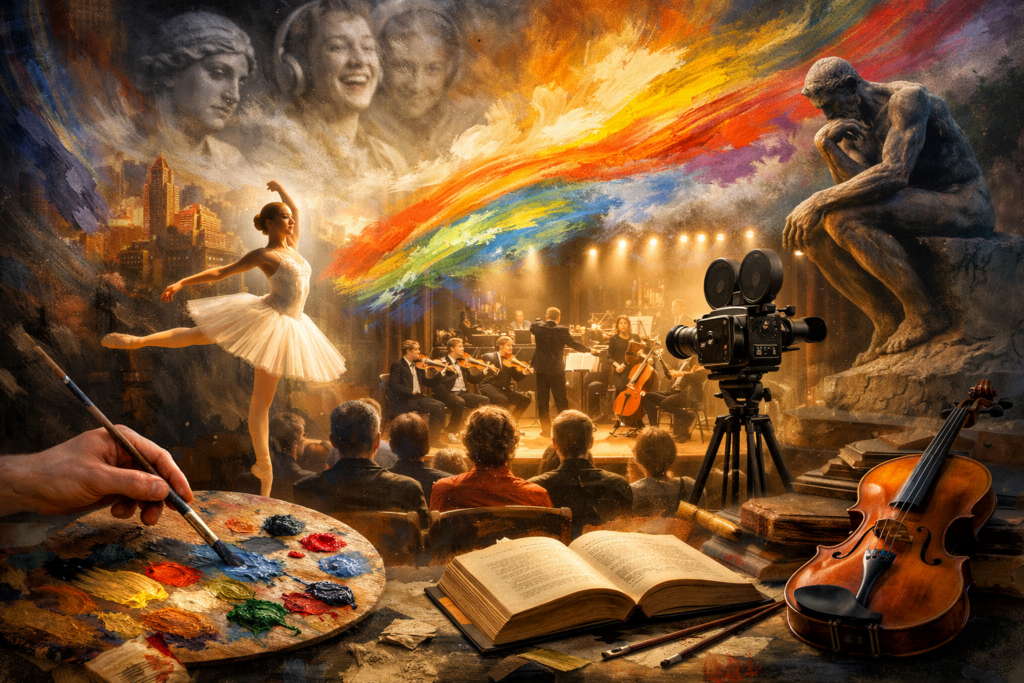
The arts are organized forms of human expression that use skill, imagination, and technique to communicate ideas and emotions. They include visual practices like painting and sculpture, performing traditions like music and theater, literary arts such as poetry and storytelling, and applied fields like design and architecture. While styles and standards change across time and place, the core purpose remains remarkably consistent: to translate inner experience into a shareable form.
Importantly, the arts are not limited to galleries or concert halls. A street mural, a wedding song, a film score, a well-designed chair, or a digital animation can all function as art when they convey meaning and invite interpretation. The arts sit at the intersection of craft (what the hands can do), concept (what the mind intends), and culture (what a community values).
Major Branches of the Arts
Visual Arts
Visual arts speak through images, materials, and spatial relationships. Drawing and painting rely on line, color, and composition to guide attention and evoke mood. Sculpture adds mass, weight, and physical presence, often shaping how viewers move around a work. Photography and film capture light and time, turning everyday moments into frames of significance.
Contemporary visual art also embraces installation, mixed media, and digital tools. The medium is not merely a vehicle; it becomes part of the message—whether that means using recycled materials to comment on consumption or augmented reality to question what “real” even means.
Performing Arts
Performing arts unfold in time and depend on live or recorded interpretation. Music organizes sound into rhythm, harmony, and texture, shaping emotion with a precision that can bypass language. Dance communicates through motion and physical vocabulary, often expressing identity, ritual, or social change. Theater combines script, voice, gesture, and design to create shared focus between performers and audience.
Even when mediated through screens, performance retains a vital quality: it is experienced moment by moment, and meaning emerges through pacing, tension, and release.
Literary Arts
Literary arts use language to build worlds, reveal character, and explore ideas. Poetry condenses meaning with sound patterns, metaphor, and rhythm. Novels and short stories expand time and perspective, allowing readers to inhabit other lives. Essays and memoirs shape personal experience into reflection, helping societies name what might otherwise remain unspoken.
In an age of fast scrolling, literary art remains a counterweight—an invitation to slow down and think with nuance.
Applied Arts and Design
Applied arts blend beauty with function. Architecture and interior design shape how we live and move; graphic design influences how we read and decide; fashion and product design negotiate identity, comfort, and status. These fields show that aesthetics are not superficial—forms influence behavior, and materials express values. A well-designed public space can invite community, while poor design can quietly exclude.
Why the Arts Matter
The Arts Preserve Culture and Memory
Artworks serve as cultural records. They document rituals, conflicts, migrations, and everyday life, often telling stories that official histories overlook. Songs preserve languages; textiles encode symbols; murals mark neighborhood identities. Even when created for entertainment, art can become a time capsule that future generations use to understand how people felt and what they feared or hoped for.
The Arts Train Empathy and Interpretation
Engaging with art strengthens the ability to interpret complexity. A novel asks readers to hold multiple motivations at once; a painting invites attention to what is emphasized and what is omitted; a play forces us to listen to voices we might avoid in real life. This interpretive practice is a social skill: it helps people tolerate ambiguity and see others as fully human.
The Arts Support Innovation
Creativity is not a mysterious talent reserved for a few—it is a process of trying, revising, and making connections. Artistic thinking encourages experimentation, comfort with iteration, and sensitivity to user experience. Many breakthroughs in technology, education, and public policy benefit from artistic approaches such as prototyping, storytelling, and visual communication.
How Art Is Made: Process Over Perfection
Behind most art is a cycle of observation, practice, and revision. Artists often start with a question or sensation, gather references, test materials, and refine choices. Failure is not a detour; it is data. Learning an instrument involves scales and repetition; writing requires drafts; choreography evolves through rehearsal; design improves through feedback.
This is one reason the arts are powerful in education: they teach persistence and attention. The final work matters, but the growth occurs in the making.
The Arts in the Digital Age
Digital tools have expanded access and blurred categories. A smartphone can be a camera, studio, and distribution platform. Musicians collaborate across continents, visual artists work with 3D modeling and generative systems, and writers publish directly to global audiences. At the same time, the digital environment raises new questions about authorship, originality, and sustainability—especially as algorithms shape what gets seen and what disappears.
Rather than replacing traditional forms, digital art often extends them. The most compelling work uses technology intentionally, not as a gimmick, asking what new experiences become possible and what risks come with them.
Practical Ways to Engage with the Arts
- Visit locally: Explore community theaters, open-mic nights, student exhibitions, and public art walks for accessible entry points.
- Practice a craft: Sketch for ten minutes a day, learn basic chords, or write short reflections—small routines build fluency.
- Look and listen slowly: Spend time with one piece rather than many; reread a poem, replay a song, or study the composition of an image.
- Talk about what you notice: Share observations without needing “the right answer.” Art invites multiple interpretations.
- Support creators: Buy tickets, commission work, credit artists, and advocate for arts education and fair pay.
Conclusion: The Arts as a Shared Human Practice
The arts endure because they meet persistent human needs: to express what is difficult to say, to find beauty amid uncertainty, to challenge power, and to connect across differences. Whether encountered in a museum, a living room, a street corner, or a screen, art asks us to pay attention. And in paying attention—deeply, patiently, and with curiosity—we become more capable of understanding ourselves and each other.