

Beyond the Board and the Screen: How Games Shape Skill, Culture, and Connection
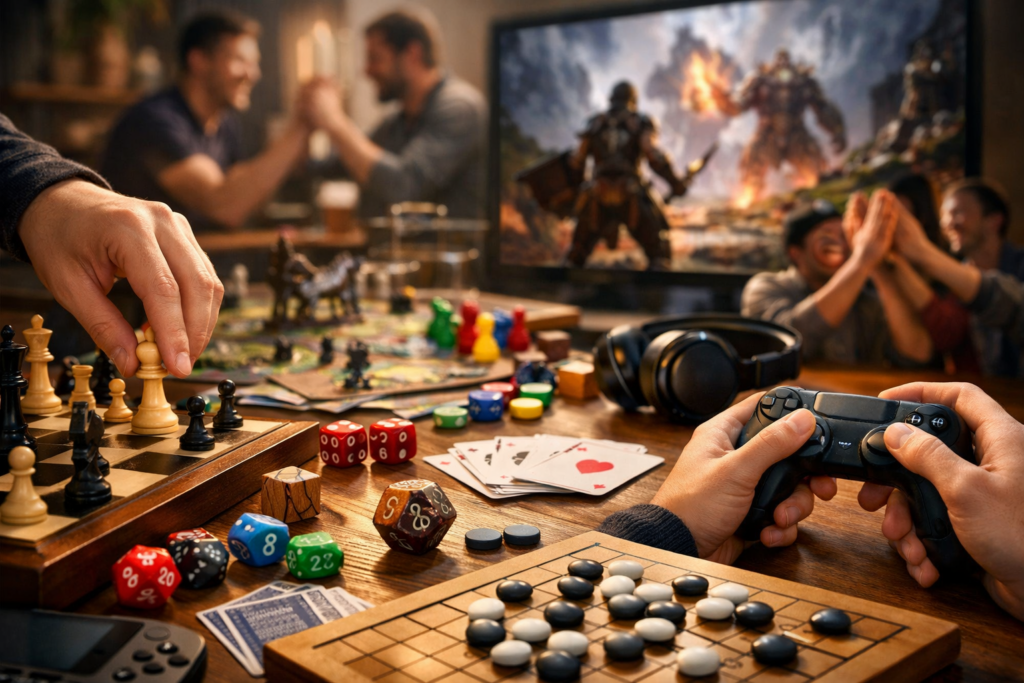
What Makes a Game a Game?
At their core, games are structured forms of play defined by goals, rules, and feedback. A game sets a challenge (reach the finish line, solve the puzzle, defeat the opponent), limits how you can act (rules and resources), and responds to your choices (scores, consequences, new opportunities). That feedback loop is what turns casual activity into a compelling experience: you try, you learn, you adjust, and you try again.
Games also create a temporary “world” with its own logic. Whether it’s a chessboard, a soccer field, a mobile screen, or a tabletop roleplaying map, the boundaries clarify what matters. Inside those boundaries, even simple actions can become meaningful because they contribute to progress, mastery, or narrative.
A Brief Tour of Game Types
Traditional and Tabletop Games
Board games, card games, and tabletop roleplaying games emphasize face-to-face interaction, shared attention, and tactile components. Modern tabletop design often blends strategic planning with storytelling and accessibility, offering options for quick party play or deep, multi-session campaigns.
Sports and Physical Games
Sports combine physical skill with teamwork, discipline, and real-time decision-making. The “game” exists not just in the rules, but in spacing, timing, stamina, and psychology. Physical games also serve as social infrastructure—communities form around local leagues, school teams, and neighborhood rivalries.
Video Games and Digital Worlds
Digital games can simulate complex systems, deliver cinematic storytelling, or create open-ended sandboxes. Online play adds persistent communities, competitive ladders, and cooperative raids. With constant updates and downloadable content, many games have become evolving services rather than static products.
Puzzles and Solo Challenges
Puzzles sit near the border between games and problem-solving, but they share the same essentials: constraints, goals, and satisfaction from progress. From crosswords to escape rooms, puzzle experiences reward pattern recognition, logic, and patience—often with minimal reliance on chance.
Why People Play: Motivation and Meaning
Games appeal to different motivations, sometimes within the same person. One player might chase mastery, another seeks social connection, and a third wants narrative immersion. Well-designed games often support multiple motivations at once, allowing different playstyles to thrive in the same space.
- Mastery: Improving skill, learning strategies, and overcoming harder challenges.
- Competition: Testing yourself against others in a fair, rule-based environment.
- Cooperation: Achieving shared goals that require communication and trust.
- Exploration: Discovering worlds, mechanics, secrets, and emergent outcomes.
- Expression: Customizing characters, building creations, roleplaying identities.
- Relaxation: Enjoying low-stress routines, cozy aesthetics, or meditative repetition.
Importantly, games can be meaningful even when the stakes are fictional. The feelings are real: pride after a hard-won victory, relief at solving a tricky puzzle, or belonging in a friendly guild.
Games as Learning Tools
Because games deliver immediate feedback, they can teach effectively. Players experiment safely, see the outcome, and iterate. This mirrors good learning environments: clear goals, manageable difficulty, and feedback that encourages persistence rather than punishment.
Many skills developed through gaming transfer outside play, especially when players reflect on what they’re doing:
- Systems thinking: Understanding how choices ripple through interconnected mechanics.
- Strategic planning: Balancing short-term gains against long-term positioning.
- Communication: Coordinating with teammates under pressure.
- Resilience: Treating failure as data and trying again with a new approach.
- Creativity: Building, modding, storytelling, and improvisation.
This doesn’t mean every game is automatically educational, but the format is naturally compatible with skill-building when design aligns with learning goals.
Design Ingredients: Rules, Chance, and Fairness
Game design is often a balancing act between clarity and possibility. Rules must be understandable, yet flexible enough to allow interesting decisions. Many games also incorporate chance—dice rolls, card draws, procedural generation—to create variety and suspense. Chance can reduce predictability, but too much randomness can make effort feel irrelevant, so designers carefully tune how much luck matters.
Fairness is equally central. In competitive games, players need confidence that outcomes reflect skill more than exploitation. This is why matchmaking systems, anti-cheat tools, and thoughtful character balancing are so important. In cooperative games, fairness often means each player feels useful—no one should be stuck doing boring chores while others get the exciting moments.
The Social Life of Games
Games are powerful social technology. They give people a reason to gather and a shared activity that reduces awkwardness. They also create “safe” conflict: rivalry with agreed-upon boundaries. For friends and families, games can become rituals—weekly board game nights, seasonal sports traditions, or online sessions that keep long-distance relationships alive.
Communities form around games in many layers: local meetups, streaming audiences, modding scenes, speedrunning communities, and esports fandoms. These spaces can be welcoming and creative, though they also require active moderation and inclusive norms to prevent toxicity and harassment.
Healthy Play in a Connected Era
Modern gaming offers immense variety, but it also introduces challenges: endless progression systems, social pressure to stay competitive, and monetization models that can encourage impulsive spending. Healthy play starts with intention. Choosing games that fit your available time, setting spending boundaries, and taking breaks when play stops feeling restorative can keep the hobby positive.
Parents and caregivers can support healthy gaming by focusing less on blanket restrictions and more on context: what the child is playing, who they are playing with, and how the game affects mood, sleep, and responsibilities.
The Future of Games
Games continue to evolve alongside technology and culture. Cross-platform play is making it easier for friends to connect regardless of device. Accessibility options—like remappable controls, colorblind modes, and difficulty customization—are expanding who can participate. Meanwhile, emerging tools such as user-generated content platforms and AI-assisted creation are lowering the barrier to designing worlds, levels, and stories.
Yet the most enduring element of games remains human: the desire to explore challenges, share experiences, and find meaning within rules. Whether played on a field, at a table, or across a global network, games offer a unique blend of structure and imagination—an invitation to try, to learn, and to connect.